Is this for you?
- You want the rent roll, arrears and deposits you already expect, plus nightly income on vacant units
- Vacancy between leases is a real cost you would rather offset than absorb
- You would like one ledger behind the owner statement instead of two systems reconciled by hand
- You are a pure long-term landlord with no interest in short stays — a dedicated rent-roll tool will be a closer fit
- You need deep US-specific compliance such as affordable-housing certification workflows
- Your portfolio is large enough that you have already built integrations you would have to unpick
Your module mix
Subscribe to exactly these — nothing else to pay for. Your application arrives with this mix pre-selected, and your organisation is provisioned with it on approval.
Tenancy onboarding that blocks the calendar, monthly invoicing, a Paid/Arrear/Due cell per tenancy per month, deposits posted to the ledger and refunded on move-out.
Maintenance work orders with SLAs, move-out inspections, building staff and assets.
A vacant furnished unit is one flag away from nightly income on your own booking site — and tenancy onboarding automatically refuses if bookings conflict.
Dispositions and owner resales through your own pipeline.
Turn-key furnishing between tenancies, quoted and invoiced.
This is the actual product
Real screenshots from a live portfolio — the screens your team would work in every day.
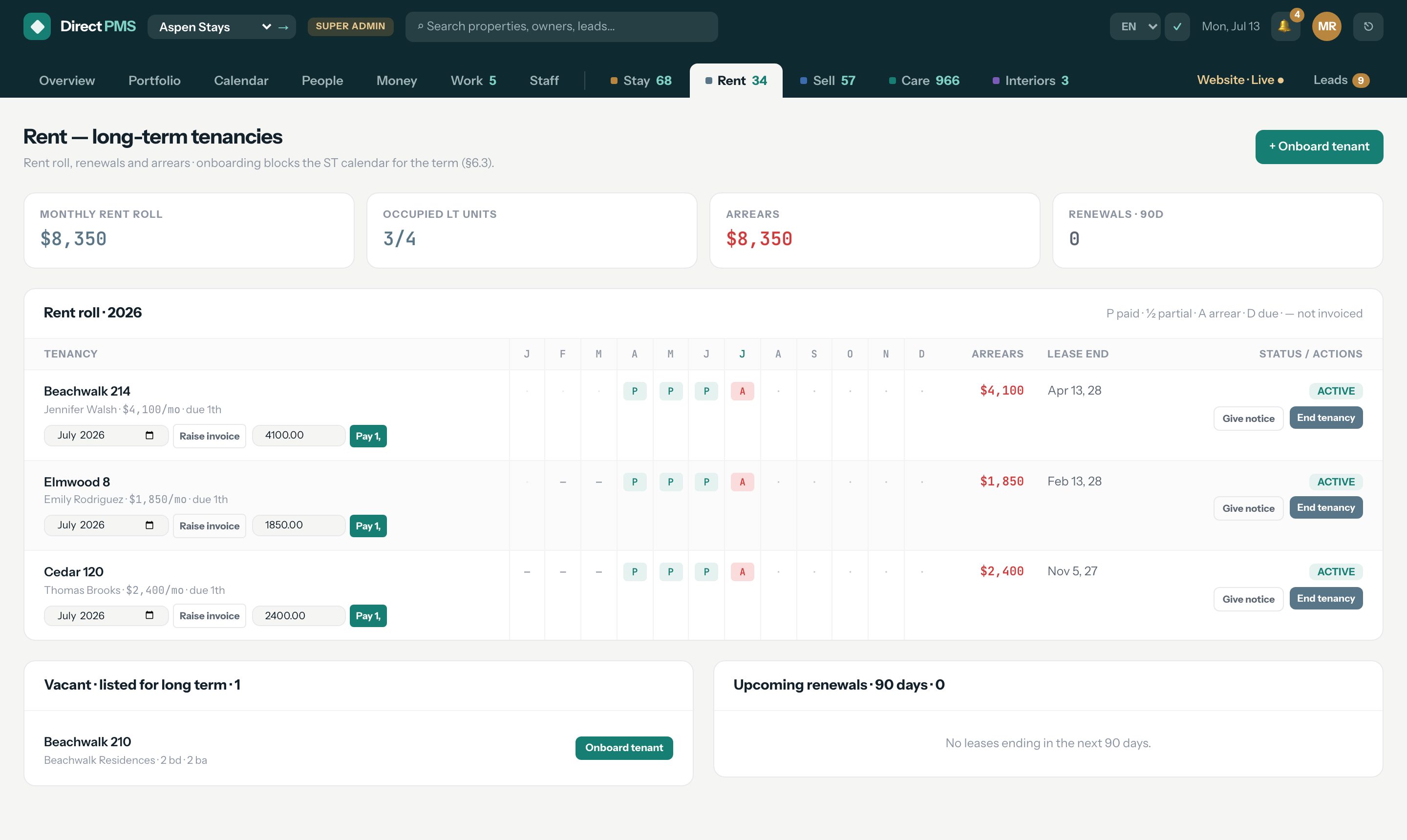
Every tenancy × every month: paid, partial, arrear or due — with invoicing and payment capture inline. The report your rent team lives in.
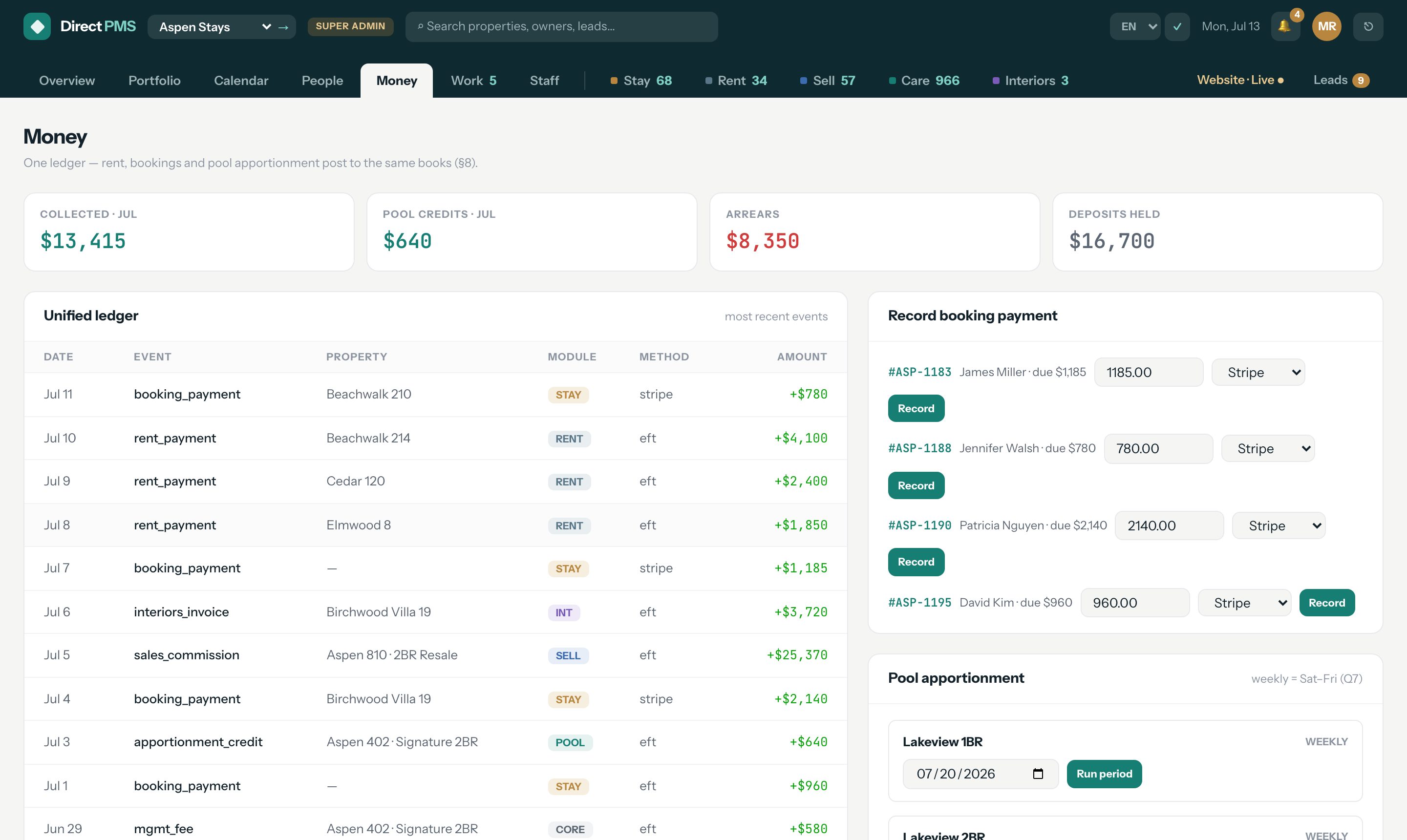
Rent, booking payments, pool revenue splits, deposits and commissions post to the same books. Statements are views, not exports.
Direct vs AppFolio / Buildium-class suites
LT and ST on one calendar per unit — structurally impossible to double-book a leased unit.
STR income means a second platform and manual calendar blocking.
A 40-unit building doesn't pay for a 4,000-unit suite.
All-in pricing built for someone else's portfolio.
Every rupee, dollar or euro posts to one ledger with FX snapshots — statements are views, not exports.
Rent in the PMS, everything else in QuickBooks.
Guides for multi-family operators
Municipal Accommodation Tax across Ontario
MAT is set city by city, and almost nothing about it is uniform — not the rate, not the stay length that triggers it, not how often you remit. Rates below are taken from each municipality's own published pages, not from an aggregator.
HST/GST on Ontario rental income
Long-term residential rent is exempt from HST. Commercial rent is taxable. Short-term stays under 30 days are treated as a commercial activity by the CRA — and the $30,000 small-supplier threshold combines every property you operate, not just one.
The Ontario Standard Lease, explained
Ontario mandates a specific government template — form 2229E — for most new residential tenancies. Its terms can't be overridden by anything a landlord writes into a side agreement.
Ontario LTB N-forms: which one applies
The Landlord and Tenant Board's N-series covers everything from a rent increase to ending a tenancy for renovation — and using the wrong one is a common, avoidable way to lose at the Board.
LTB Form N4: non-payment of rent
The most-served notice in Ontario, and the one most often served wrong — usually by miscounting the notice period or filing the L1 too early.
LTB Form N12: landlord or purchaser needs the unit
The form for when a landlord, a purchaser, or an immediate family member genuinely needs the unit — and the one the Board scrutinises hardest, because it is the one most often used as a pretext.
LTB Form N13: demolition, conversion or major repairs
The longest notice in the N-series, for work extensive enough to genuinely require an empty unit — with a right of return that defeats the reason most landlords are tempted to use it.
LTB Form N1: increasing the rent
Ontario's guideline is 2.1% for 2026 and 1.9% for 2027 — but the exemption for buildings first occupied after November 2018 matters more to a growing portfolio than the rate does.
LTB Form N9: the tenant's notice to end a tenancy
The only N-form the tenant serves. Landlords search for it constantly — usually because they have been handed one, or because they are about to make the mistake of sending one.
Why the best operators don't pick one business line
Long-term leasing, short-term stays, sales, caretaking and fit-outs get sold as five different software categories. Operationally, they're one registry with five ways to earn from it.