Is this for you?
- You run buildings and the owners keep asking you to handle their units as well
- Your site team — security, housekeeping, MEP, outsourced vendor labour — is currently a spreadsheet
- You want keys, parcels and assets on a register rather than in a book at the desk
- You need statutory HOA accounting — reserve-fund studies, formal budget balloting, lien filing
- Dues collection and violation tracking are the whole job and no owner ever asks for more
- You are contractually required to stay on a board-mandated association platform
Your module mix
Subscribe to exactly these — nothing else to pay for. Your application arrives with this mix pre-selected, and your organisation is provisioned with it on approval.
Work orders with priority and assignees, fixed assets with reorder alerts, key and mail custody, and the staff attendance matrix for security, housekeeping and MEP crews — including outsourced vendor staff.
Owners who lease out their units become a revenue line, not an email chain: tenancies, deposits, a year rent-roll per unit, arrears at a glance.
Resales stay in-house. A pipeline from enquiry to close, with your commission posting to the ledger the day the deal closes.
If owners want holiday income from vacant units, flip a flag — the unit becomes bookable on your own site with 0% commission.
Furnishing and renovation packages for new owners — quote, confirm, invoice.
This is the actual product
Real screenshots from a live portfolio — the screens your team would work in every day.
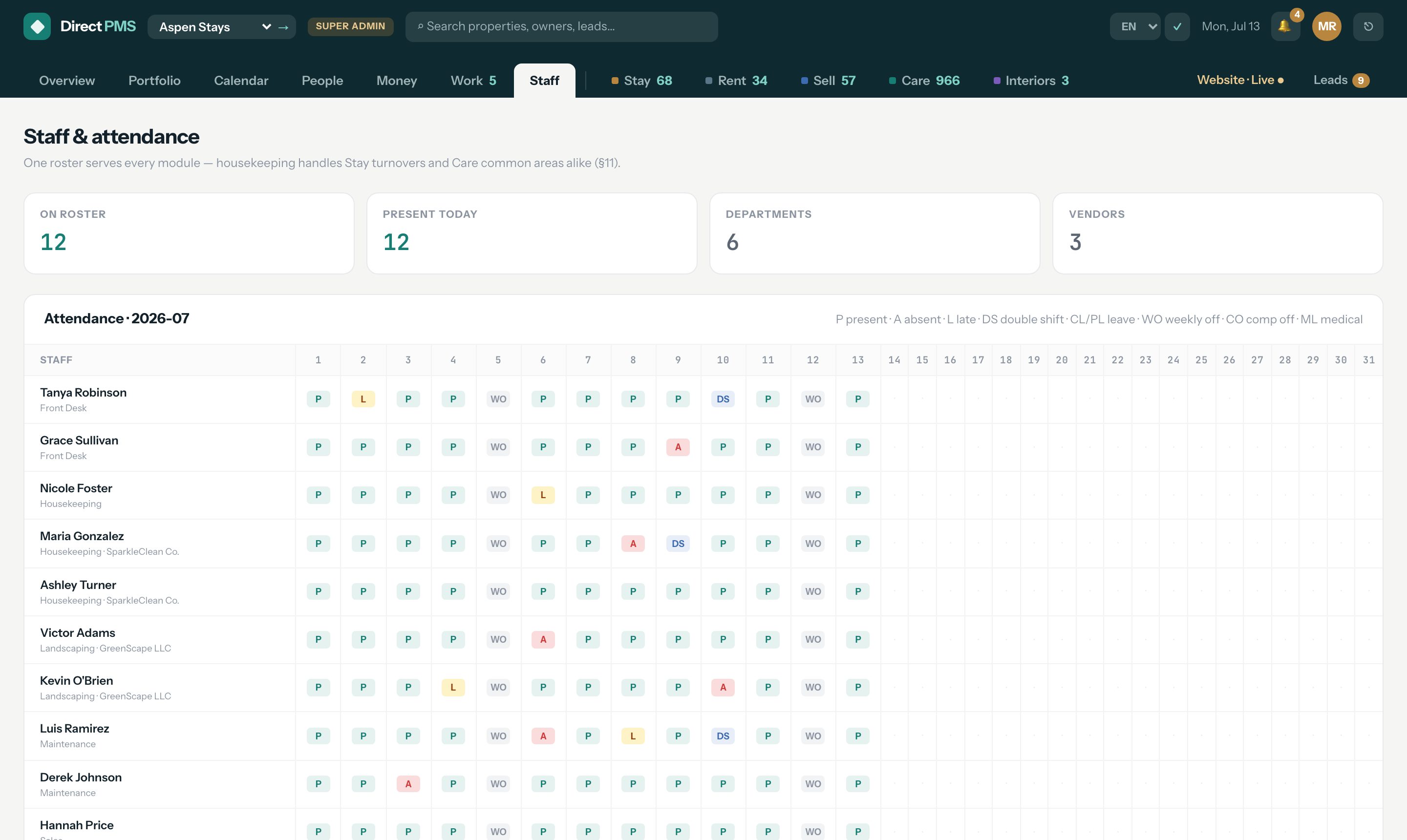
Month × staff with nine day codes — presents, absents, double shifts, leave — per department, with vendor attribution for outsourced crews.
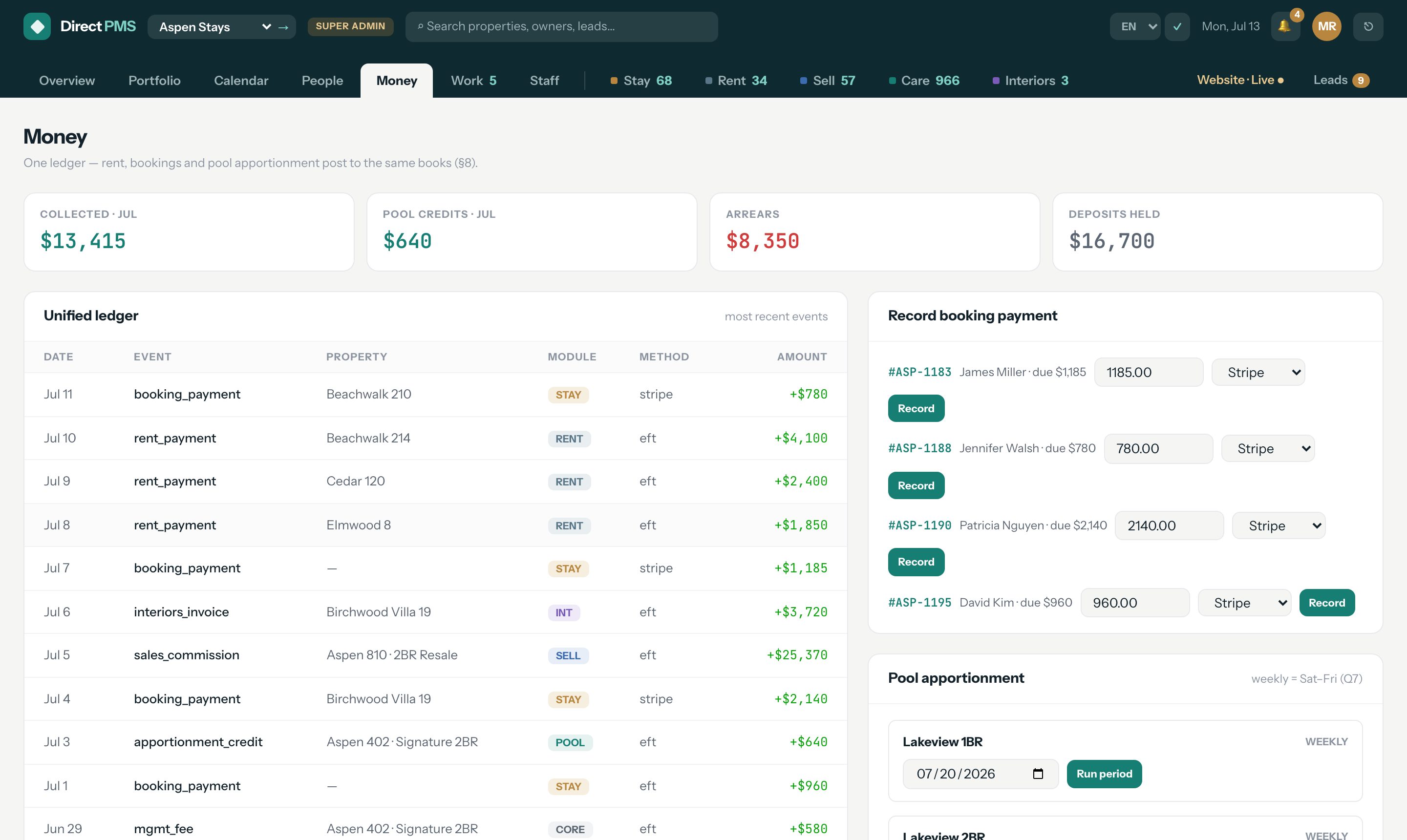
Rent, booking payments, pool revenue splits, deposits and commissions post to the same books. Statements are views, not exports.
Direct vs HOA / condo association software
Departments, day-code attendance (P/A/L/DS…), vendor attribution for outsourced labour billing.
HOA tools track dues; your 55-person site crew is a spreadsheet.
Rent, resale and holiday income per unit, all on one owner statement.
Owner rentals live in a second system — entered twice, reconciled by hand.
Keys and parcels check in and out with holder names and timestamps.
A register book at the security desk.
Guides for condo managers
British Columbia's short-term rental rules
BC moved short-term rental regulation from the municipality to the province: a principal-residence requirement in most communities, a provincial registry, and a duty on the platforms to enforce both.
Quebec tourist accommodation: CITQ registration
Quebec put the enforcement duty on the platforms: a listing without a valid registration number is one the platform is not allowed to publish, and the fines for publishing it anyway are aimed at the platform as much as the host.
Florida vacation rentals: licence, preemption and three taxes
Florida is one of the few states that licenses vacation rentals itself — and one of the few that stops its cities doing the same, unless they were already doing it in 2011.
California short-term rentals: a city-by-city map
There is no California short-term rental law to comply with. There are roughly five hundred municipal ones, and the only safe assumption is that the city you are buying in does something different from the city you already operate in.
New York City: Local Law 18 and the 30-day line
New York did not ban short-term rentals. It required registration, then required the platforms to check it — which removed most of the market in a single step, because most of the market could never have registered.
San Francisco: residency, registration and the 90-night cap
San Francisco's regime is the strictest of the residency-based models: you must actually live there, you must register, and the city audits the count of nights you were not home.
Kurzzeitvermietung in Deutschland: was gilt
Deutschland regelt Kurzzeitvermietung nicht im Bund, sondern über das Zweckentfremdungsrecht der Länder und die Satzungen der Städte — mit dem Ergebnis, dass die Frage nie „ist das erlaubt“ lautet, sondern „in welchem Bezirk“.
Alquiler turístico en España: qué se aplica
El registro es estatal y la autorización no lo es: el número identifica la vivienda ante las plataformas, pero quien decide si puede dedicarse al alquiler turístico sigue siendo la comunidad autónoma y, sobre todo, el ayuntamiento.
Alojamento Local em Portugal: o que se aplica
O registo de alojamento local é municipal e o número é público: tem de constar do anúncio, a plataforma verifica-o, e a zona onde o imóvel está decide se há sequer registo a obter.
Locazioni brevi in Italia: che cosa si applica
L'Italia ha aggiunto un livello nazionale — il CIN e i requisiti di sicurezza — sopra i codici regionali che già esistevano, senza sostituirli: oggi servono entrambi.
Hébergement touristique au Québec : l'enregistrement CITQ
Le Québec a mis l'application entre les mains des plateformes : une annonce sans numéro valide est une annonce qu'elles n'ont pas le droit de publier, et les amendes visent la plateforme autant que l'exploitant.
Location à court terme à Toronto : l'enregistrement
Toronto encadre la location à court terme par un enregistrement obligatoire plutôt que par un permis discrétionnaire — et les règles diffèrent nettement selon que vous louez le logement entier ou une chambre chez vous.
Location à court terme à Ottawa : le permis
Ottawa combine un permis d'hôte, la règle de la résidence principale en zone urbaine et une catégorie à part pour les chalets ruraux — trois régimes dans une même ville.
Location à court terme en Colombie-Britannique
La Colombie-Britannique a fait passer l'encadrement de la municipalité à la province : une règle de résidence principale dans la plupart des collectivités, un registre provincial, et l'obligation pour les plateformes d'appliquer les deux.
Toronto STR registration: what applies to you
Toronto regulates short-term rentals through mandatory registration, not a discretionary licence — and the rules differ sharply depending on whether you're renting a whole unit or a room in your own home.
Toronto's Municipal Accommodation Tax, explained
MAT applies to almost every short stay in Toronto, and the rate has moved twice in the last fourteen months — as of 8 August 2026 it's back down to 6%, after a temporary jump to 8.5%.
Toronto's Vacant Home Tax: the annual declaration
Every residential property owner in Toronto must declare occupancy status every year — even an occupied home — or the property is automatically deemed vacant and taxed at 3% of its assessed value.
Ottawa short-term rental host permits
Ottawa permits short-term rentals only in your principal residence, under a two-year host permit — with one significant exception for rural properties that Toronto has no equivalent of.
Mississauga short-term rental licences
Mississauga licenses short-term rentals in your principal residence only, for $283 a year, with a 180-night annual cap and two requirements — a police check and $2 million of liability cover — that take longer to obtain than the licence itself.
The Ontario Standard Lease, explained
Ontario mandates a specific government template — form 2229E — for most new residential tenancies. Its terms can't be overridden by anything a landlord writes into a side agreement.
LTB Form N4: non-payment of rent
The most-served notice in Ontario, and the one most often served wrong — usually by miscounting the notice period or filing the L1 too early.
LTB Form N12: landlord or purchaser needs the unit
The form for when a landlord, a purchaser, or an immediate family member genuinely needs the unit — and the one the Board scrutinises hardest, because it is the one most often used as a pretext.
LTB Form N13: demolition, conversion or major repairs
The longest notice in the N-series, for work extensive enough to genuinely require an empty unit — with a right of return that defeats the reason most landlords are tempted to use it.
LTB Form N1: increasing the rent
Ontario's guideline is 2.1% for 2026 and 1.9% for 2027 — but the exemption for buildings first occupied after November 2018 matters more to a growing portfolio than the rate does.
LTB Form N9: the tenant's notice to end a tenancy
The only N-form the tenant serves. Landlords search for it constantly — usually because they have been handed one, or because they are about to make the mistake of sending one.
Why the best operators don't pick one business line
Long-term leasing, short-term stays, sales, caretaking and fit-outs get sold as five different software categories. Operationally, they're one registry with five ways to earn from it.